Thyroid Nodule Treatment Without Surgery: A Guide to RFA for Patients in Qatar
Written by the IRCC Pakistan editorial team | Medically reviewed by Dr. Shahbaz Ahmed Qazi, Interventional Radiologist | Last updated: October 2026
Quick answer: A benign thyroid nodule that causes a visible lump, pressure or difficulty swallowing can often be treated without surgery using radiofrequency ablation (RFA). A thin needle is placed into the nodule under ultrasound and heat is used to shrink it. There is no neck scar, it is done under local anesthetic, most patients go home the same day, and the thyroid usually keeps working normally.
Thyroid nodules are often found by chance, during a routine scan in Doha or when someone notices a swelling in the neck in a photo. Most turn out to be harmless. The worry starts when the nodule keeps growing, becomes visible, or begins pressing on the throat, and the advice is to remove half or all of the thyroid.
For many people with benign nodules, there is a gentler option. This guide explains RFA in simple terms, what the evidence shows, and how patients living in Qatar can arrange it in Pakistan.
What is a thyroid nodule?
A thyroid nodule is a lump inside the thyroid gland, the butterfly-shaped gland at the front of the neck. Nodules can be solid, filled with fluid, or a mix of both. They are very common, especially in women and as people get older, and the large majority are not cancer.
Do thyroid nodules go away on their own?
Some fluid-filled nodules shrink by themselves, but most solid nodules stay the same size or grow slowly. Small benign nodules that cause no symptoms are usually just watched with an ultrasound every so often.
When does a benign nodule need treatment?
- A lump you can see or feel in the neck, which bothers you
- A feeling of pressure, tightness or something stuck in the throat
- Difficulty swallowing, or a cough when lying flat
- A nodule that keeps growing on follow-up scans
- A 'hot' nodule producing too much thyroid hormone (some cases)
The first step: making sure the nodule is benign
RFA is only for nodules that have been confirmed as non-cancerous. This is usually done with a fine needle aspiration (FNA), where a thin needle takes a few cells from the nodule under ultrasound for testing. Many doctors prefer two benign results before ablation. If you have already had an FNA in Qatar, bring the report. If not, it can be arranged.
The UK's National Institute for Health and Care Excellence (NICE) has reviewed this procedure and states that ultrasound-guided RFA for benign thyroid nodules is safe enough and works well enough for routine use, provided the nodule has been checked and found to be benign beforehand.
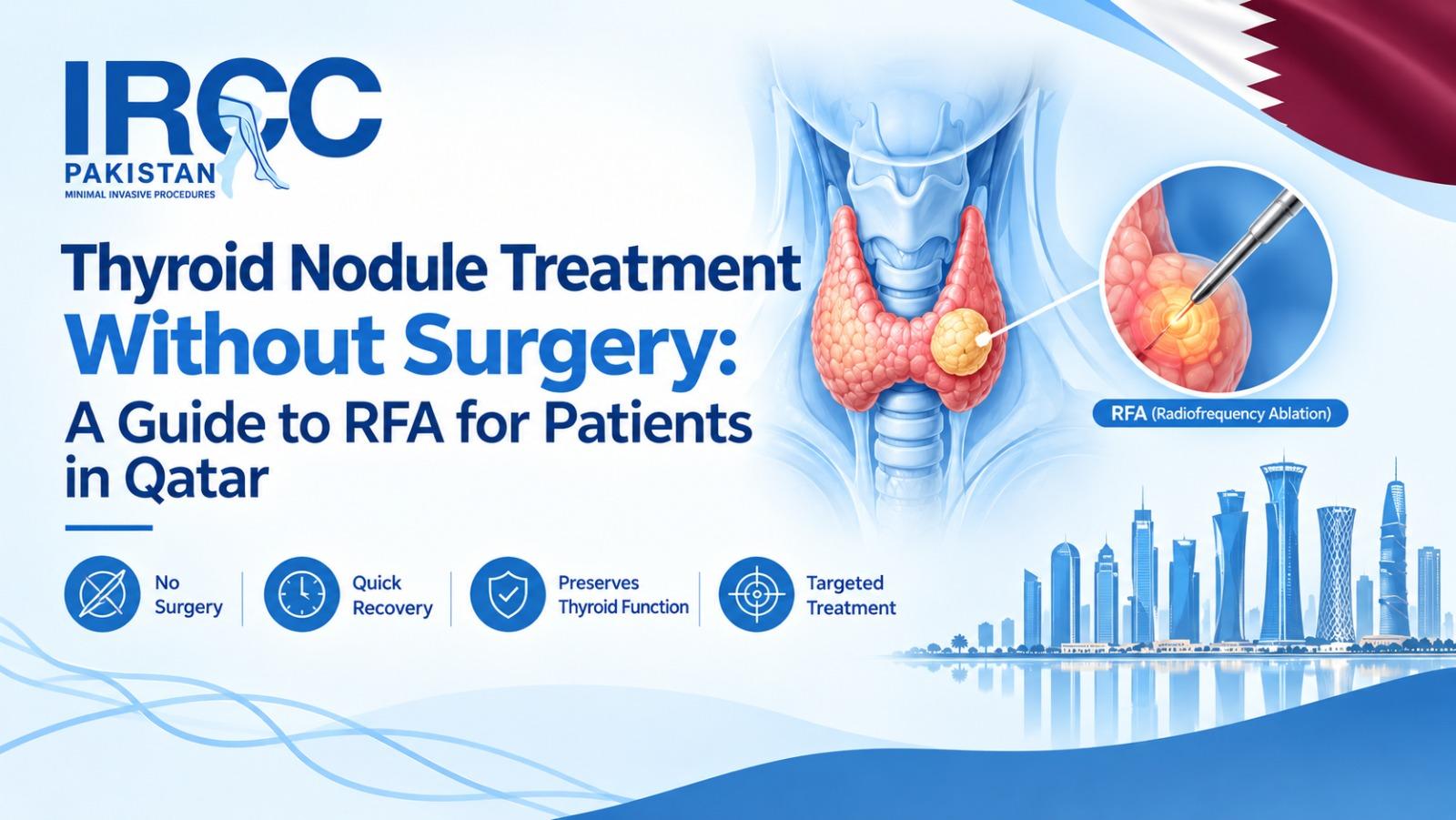
How thyroid radiofrequency ablation works
- You lie on your back with your neck slightly extended. The skin is numbed with local anesthetic.
- Using live ultrasound, the doctor guides a thin electrode needle into the nodule.
- Controlled heat is applied to the nodule bit by bit, while the doctor watches on screen to protect the nerves and blood vessels nearby.
- The procedure takes around 20 to 60 minutes depending on the size of the nodule.
- You rest with an ice pack on the neck for a short while and usually go home the same day.
The treated tissue is gradually absorbed by the body. That is why the nodule keeps shrinking over several months rather than vanishing overnight.
RFA vs thyroid surgery
| Factor | Radiofrequency ablation | Thyroid surgery |
|---|---|---|
| Anesthesia | Local | General |
| Scar | None, only a needle mark | Neck scar, usually 4 to 6 cm |
| Hospital stay | Usually same day | 1 to 3 nights |
| Thyroid function | Usually preserved | Lifelong thyroid tablets after total removal |
| Back to work | 1 to 2 days | 1 to 3 weeks |
| Suitable for cancer | No | Yes |
| Nodule result | Shrinks gradually over months | Removed at once |
Surgery remains the right choice for suspected or confirmed cancer, for very large goiters that extend into the chest, and for some nodules that cannot be reached safely with a needle.
What results can you expect?
Studies commonly report the nodule shrinking by about half to four-fifths of its original volume within the first year, with most of the reduction in the first six months. Symptoms such as pressure and the visible lump usually improve as the nodule shrinks. Very large nodules sometimes need a second session.
Serious complications are uncommon. The one patients ask about most is a change in voice, which can happen if the nerve to the voice box is irritated. In most reported cases this is temporary. Your doctor should talk you through all the risks before you agree to treatment.
Recovery timeline
| Time after RFA | What most patients experience |
|---|---|
| Same day | Mild soreness or swelling in the neck. Home after a short rest. |
| Day 1 to 3 | Back to normal light activity and office work. |
| Week 1 | Any swelling or tenderness settles. |
| Month 1 | First follow-up ultrasound, which can be done in Qatar. |
| Month 6 to 12 | Most of the size reduction is seen. Further follow-up scans as advised. |
Thyroid RFA cost: Qatar vs Pakistan
Based on IRCC's own indicative estimates for patients from Qatar:
| Procedure | Estimated cost in Pakistan | Estimated cost in Qatar |
|---|---|---|
| Thyroid radiofrequency ablation (RFA) | Around QAR 6,950 | Around QAR 31,760 |
These figures are for planning only. The final cost depends on nodule size, how many nodules need treating, whether an FNA is needed first, and length of stay. Ask for a written estimate after your reports have been reviewed, and remember to include flights and accommodation.
How Qatar residents can plan thyroid RFA in Pakistan
Flights from Doha to Karachi, Lahore and Islamabad take roughly three to four hours. Patients from Doha, Al Wakrah, Al Rayyan, Al Khor and Lusail can start with a remote review, and you do not need to be Pakistani to be treated.
- Send your latest thyroid ultrasound, FNA (biopsy) report and thyroid blood tests (TSH, T4).
- Speak with the interventional radiologist to confirm whether RFA is suitable.
- Agree the date, city and estimated cost before booking travel.
- Plan to stay around two to four days in total.
- Book your one-month follow-up ultrasound in Qatar and share it with the IRCC team.
You can find the full step-by-step process on our page for medical treatment in Pakistan for Qatar patients.
Frequently asked questions
Is thyroid RFA painful?
The area is numbed, so most patients feel pressure and warmth rather than sharp pain. Some feel discomfort spreading to the jaw or ear for a few seconds during the heating, which stops when the doctor pauses.
Will I need thyroid tablets after RFA?
Most patients do not, because only the nodule is treated and the rest of the gland keeps working. Your thyroid levels will be checked during follow-up.
Can RFA treat thyroid cancer?
This guide is about benign nodules. RFA is not a standard treatment for a newly diagnosed thyroid cancer, which is why a benign biopsy result is needed first.
Will the nodule disappear completely?
Usually it shrinks a lot but does not vanish entirely. What remains is often small enough that it is no longer seen or felt.
Can nodules grow back after RFA?
Regrowth can happen, particularly with large nodules, and can usually be treated with another session. Regular ultrasound follow-up helps catch this early.
How soon can I fly back to Doha?
Most patients fly one to two days after the procedure, once the doctor has checked the neck.
Related reading
Thyroid Radiofrequency Ablation at IRCC Pakistan
Fibroid Treatment Without Surgery: A Guide for Women Living in the UAE
Varicocele Treatment Without Surgery: A Guide for Men in Saudi Arabia
Medical disclaimer: This article is for general information and does not replace a consultation. Treatment decisions should be made after a personal assessment by a qualified doctor.
References
NICE HealthTech guidance HTG416 (formerly IPG562): Ultrasound-guided percutaneous radiofrequency ablation for benign thyroid nodules. https://www.nice.org.uk/guidance/htg416
Mayo Clinic: Thyroid nodules, symptoms and causes. https://www.mayoclinic.org/diseases-conditions/thyroid-nodules/symptoms-causes/syc-20355262