logo
Back to Blog

Piles Treatment Without Surgery: Options and What to Expect
Nov 23, 2026|6 min read|IRCC clinic team
Piles treatment without surgery: options and what to expect - IRCC Pakistan

Reviewed by: Dr Shahbaz Ahmed Qazi (FCPS, FRCR, EBIR).

Quick answer: Piles, also called haemorrhoids, are swollen veins in the lower rectum and around the anus. Many cases settle with more fibre, fluids and simple care. When symptoms continue, a specialist may discuss options that do not need open surgery, such as embolization for selected patients. Any rectal bleeding should be checked by a doctor.

Piles can be uncomfortable, embarrassing to talk about and hard to ignore. Many people put off a visit, and some look for surgery as the only answer. In most cases it is not the first step. This guide explains the common symptoms, when to see a doctor, the treatment options that are discussed without open surgery and what to expect. For selected patients, a specialist may also talk about Hemorrhoidal Artery Embolization, a newer procedure that is still being studied.

What are piles (haemorrhoids)?

Piles are swollen veins in the lining of the anus and lower rectum. Everyone has these veins. They become a problem when they swell, stretch or bleed. Doctors describe piles as internal, which sit inside the rectum, or external, which sit under the skin around the anus. Some piles are both.

Piles are very common. Most people with piles get better with simple care, and only a small number need treatment beyond diet and medicines.

Symptoms of piles

SymptomWhat it can feel likeWhat to do
Bleeding when passing stoolBright red blood on the toilet paper or in the bowlSee a GP to confirm the cause, even if you think it is piles
Itching around the anusItchy or sore skin, often after passing stoolGentle cleaning and a GP review if it lasts
A lump or swellingA soft lump at the anus, sometimes with discomfort when sittingSee a GP if it does not go away
PainPain or soreness, mostly with external piles or a clotSee a GP. A clot that is very painful needs a quick check
ProlapsePiles that come out during or after passing stool, then go back inSee a GP, as treatment depends on how far they come out

Symptoms can come and go. Bleeding is the symptom that most needs a doctor's check, because other conditions can cause it too.

Causes and risk factors

Piles are linked to pressure in the veins of the lower rectum. Anything that raises that pressure over time can make piles more likely.

  • Constipation and straining when passing stool.
  • Low fibre and low fluid intake, which make stools harder to pass.
  • Long periods of sitting, especially on the toilet.
  • Pregnancy and childbirth, when pressure on the pelvic veins is higher.
  • Extra body weight, and a family history of piles.

Self-care that often helps

Simple changes help many people, and they are the first step a GP usually advises. They do not replace a check for bleeding.

  • Eat more fibre from vegetables, fruit, beans, lentils and whole grains. Increase it slowly, so the bowel can adjust.
  • Drink enough fluids through the day, unless a doctor has told you to limit fluids.
  • Do not sit on the toilet for long periods, and do not strain to pass stool.
  • Keep the anal area clean and dry, using gentle wipes or warm water.
  • Ask a GP or pharmacist about creams or suppositories for short term relief, and the safe way to use them.

Tests a specialist may order

Most piles are diagnosed from the history and a short examination. Tests are added when the diagnosis is unclear, or when bleeding needs a full check of the bowel.

TestWhat it checksWhere it is done
ExaminationThe anus and lower rectum, to look for piles and other causes of bleedingGP or clinic
Anoscopy or proctoscopyA short tube with a light, to see the lower rectum and pilesGP, clinic or hospital
Sigmoidoscopy or colonoscopyA longer look inside the bowel, when the cause of bleeding is not clearHospital, on referral
Blood testsBlood loss and iron levels, when bleeding has been present for some timeGP

A check of the whole bowel is important for anyone over the usual screening age, or with a family history of bowel disease. Your doctor will explain which test is needed.

Treatment options to discuss

Treatment depends on the type of piles, how severe the symptoms are and how much they limit daily life. Most people start with the first two options. A specialist reviews the others if symptoms continue.

OptionWhen it is discussedPoints to ask about
Diet, fluids and bowel habit changesAlmost always, as the first stepWhich changes to make, and when to review
Creams or suppositoriesFor short term relief of itching, pain or swellingWhich product is suitable, and how long to use it
Rubber band ligationFor internal piles that keep coming back, done in a clinicHow many sessions may be needed, and what to expect after
Injection sclerotherapyFor smaller internal piles, in selected patientsWhat the injection does and how it is followed up
Haemorrhoidal artery embolizationFor selected patients when other care has not helped enough. A newer procedure that is still being studiedWhether you are suitable, what the team expects, recovery and follow up
Surgery (haemorrhoidectomy)For large or repeated piles, or when other options have not workedRisks, recovery time and the reasons it is advised for you

Each option has risks and benefits. Ask your specialist what result to expect for your case, and when the plan will be reviewed. No option works the same way for everyone.

Recovery: what to expect

Recovery depends on the treatment. Less invasive options usually allow a quicker return to normal activity than surgery, but each person is different. Ask the team for the typical time off work, the diet and activity advice, and the signs that need a call.

Mild discomfort after a procedure is common. Pain that gets worse, fever, heavy bleeding or difficulty passing urine after treatment needs urgent review.

Common myths about piles

Piles always need surgery

Most piles are treated without surgery. Surgery is usually considered when other options have not helped over a long period, or when piles are large.

If there is bleeding, it must be piles

Bleeding can be caused by piles, but it can also be caused by other conditions of the bowel. A doctor should check bleeding before piles are assumed to be the cause.

Creams cure piles for good

Creams and suppositories help with symptoms, but they do not remove the veins. Lifestyle changes help keep symptoms under control.

What to expect at your first visit

The GP will ask about your symptoms, how long they have lasted, bowel habits, diet, pregnancy history and any family history of bowel disease. An examination is usually done, and tests are arranged if needed. Bring a note of the bleeding or symptoms, and write down your questions so that nothing is missed.

Related guide: Is It Dangerous Not to Treat Varicose Veins?. To talk to a specialist about your reports, use the consultation request page.

References

Frequently Asked Questions

Can piles be treated without surgery?

Yes. Many people with piles improve with diet, fluids, bowel habit changes and medicines from a GP or pharmacist. Some procedures that do not need open surgery are discussed for selected patients when those steps have not helped enough.

Is rectal bleeding always caused by piles?

No. Piles are a common cause of bleeding, but other conditions can cause it too. Any new or repeated bleeding should be checked by a GP, so that the right cause is found.

How long do piles last?

Piles can come and go. Symptoms often improve with changes to diet and bowel habits. Piles that keep coming back or cause bleeding are reviewed by a specialist, who can explain the options.

Does embolization for piles hurt?

Discomfort after the procedure varies from person to person. The specialist explains what to expect, the pain relief used and the recovery plan before the procedure is booked.
From the Blogs

Nov 23, 2026
Can a Varicocele Go Away on Its Own?

Can a Varicocele Go Away on Its Own?

A varicocele does not usually disappear on its own, but many never need treatment. Learn when it is monitored, when treatment is discussed and the warning signs.

Nov 23, 2026
Varicocele Grades Explained: What Your Scan Report Means

Varicocele Grades Explained: What Your Scan Report Means

Varicocele grades 1 to 3 describe how large the veins are. Learn what each grade means, what a scrotal ultrasound report says and when treatment is discussed.

Nov 23, 2026
Piles Treatment Without Surgery: Options and What to Expect

Piles Treatment Without Surgery: Options and What to Expect

Most piles settle without surgery. Learn the symptoms that need a check, the self-care that helps, the non surgical options and what recovery involves.

Nov 23, 2026
Blocked Fallopian Tubes: Causes, Tests and Options

Blocked Fallopian Tubes: Causes, Tests and Options

Blocked fallopian tubes can stop the egg and sperm from meeting. Learn the common causes, how the HSG test checks the tubes and the options to discuss.

Nov 17, 2026
Chronic Knee Pain Without Surgery: Options to Discuss

Chronic Knee Pain Without Surgery: Options to Discuss

Long term knee pain is most often caused by osteoarthritis. Learn the non surgical options doctors discuss, what each one involves and when to get a check.

Nov 17, 2026
Morning Heel Pain: Plantar Fasciitis Causes and Care

Morning Heel Pain: Plantar Fasciitis Causes and Care

Heel pain that is worst with the first steps in the morning is often plantar fasciitis. Learn the causes, the self-care to try first and when to get a check.

Nov 17, 2026
Leg Pain When Walking: Causes That Need a Check

Leg Pain When Walking: Causes That Need a Check

Calf or thigh pain that starts when you walk and eases with rest can be a sign of poor circulation. Learn the causes, the warning signs and the tests.

Nov 17, 2026
Pelvic Pain in Women: Common Causes and When to Get Checked

Pelvic Pain in Women: Common Causes and When to Get Checked

Pelvic pain can come from the womb, ovaries, bladder, bowel or pelvic veins. Learn the common causes, the warning signs and the tests that find the cause.

Nov 13, 2026
Enlarged Prostate Symptoms: When to See a Urologist

Enlarged Prostate Symptoms: When to See a Urologist

A weak flow, needing to pee often and getting up at night are common enlarged prostate symptoms. Learn which signs need urgent help, the tests and the options.

Nov 13, 2026
Thyroid Lumps: Are They Cancer? Tests Explained

Thyroid Lumps: Are They Cancer? Tests Explained

Most thyroid lumps are not cancer. Learn which tests check a lump, why a biopsy is not always needed, what a blood test can show and when to see a specialist.

Nov 12, 2026
Varicose Veins vs Spider Veins: How to Tell the Difference

Varicose Veins vs Spider Veins: How to Tell the Difference

Spider veins are small, flat and mostly cosmetic. Varicose veins are larger, bulging and can cause symptoms. Learn how to tell them apart and when to get a check.

Nov 12, 2026
Varicocele Symptoms in Men: Pain, Swelling and When to Test

Varicocele Symptoms in Men: Pain, Swelling and When to Test

A dull ache, a soft scrotal swelling or a smaller testicle can be varicocele symptoms. Learn the warning signs, the fertility tests and when to see a specialist.

Nov 11, 2026
Heavy Periods and Fibroids: Signs You Should Not Ignore

Heavy Periods and Fibroids: Signs You Should Not Ignore

Fibroids can cause heavy periods, but they are not the only cause. Learn the warning signs, the tests that find the cause and when to see a doctor.

Nov 10, 2026
Can Fibroids Affect Fertility? What Women Should Know

Can Fibroids Affect Fertility? What Women Should Know

Fibroids affect fertility in some women and not in others. Learn how fibroid size and location matter, which tests help and what to ask your doctor.

Oct 21, 2026
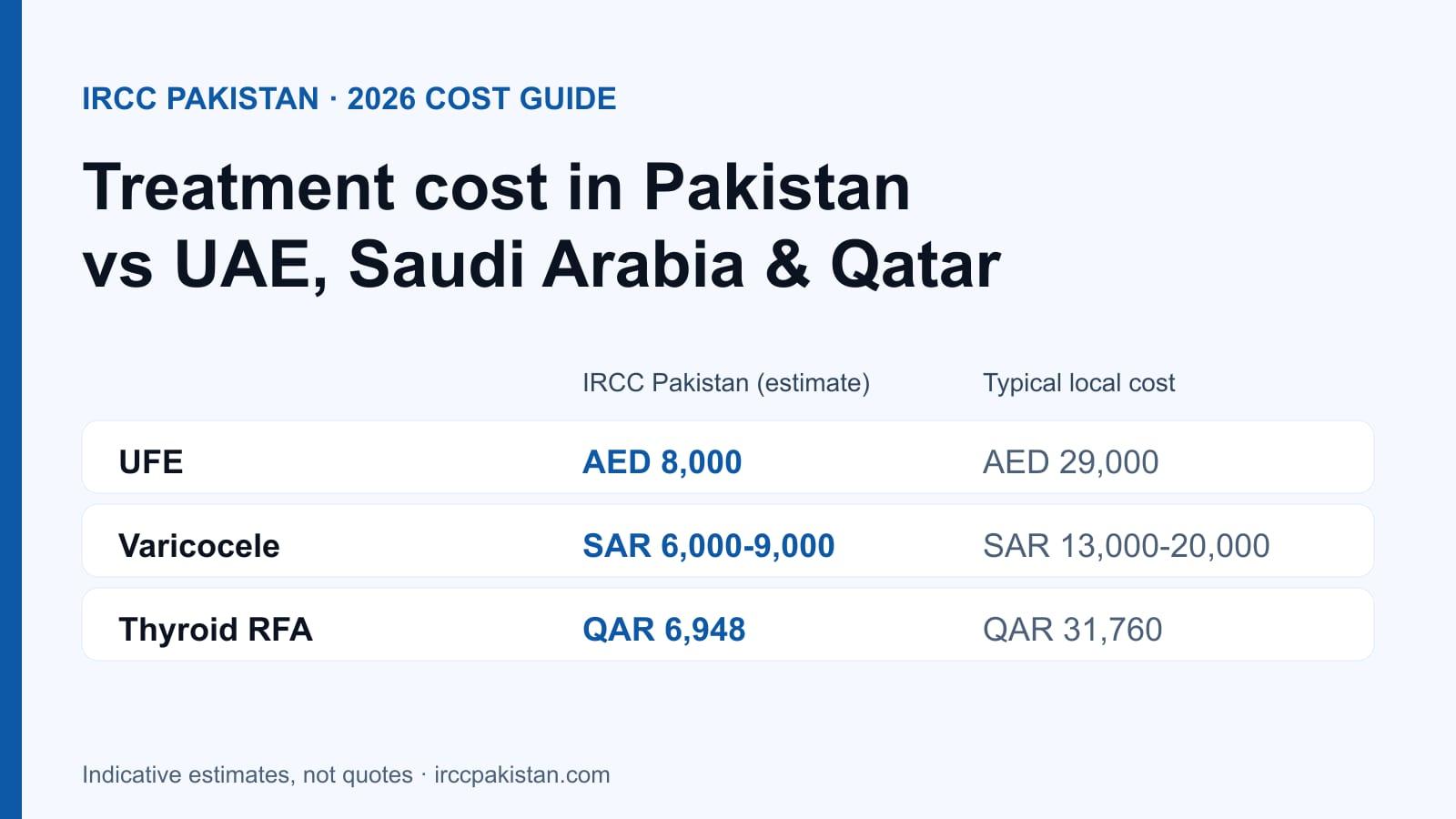
Treatment Cost in Pakistan vs UAE, Saudi Arabia and Qatar (2026)

Treatment Cost in Pakistan vs UAE, Saudi Arabia and Qatar (2026)

Indicative 2026 costs for five non-surgical procedures at IRCC Pakistan compared with typical costs in the UAE, Saudi Arabia and Qatar, in AED, SAR and QAR.

Oct 16, 2026
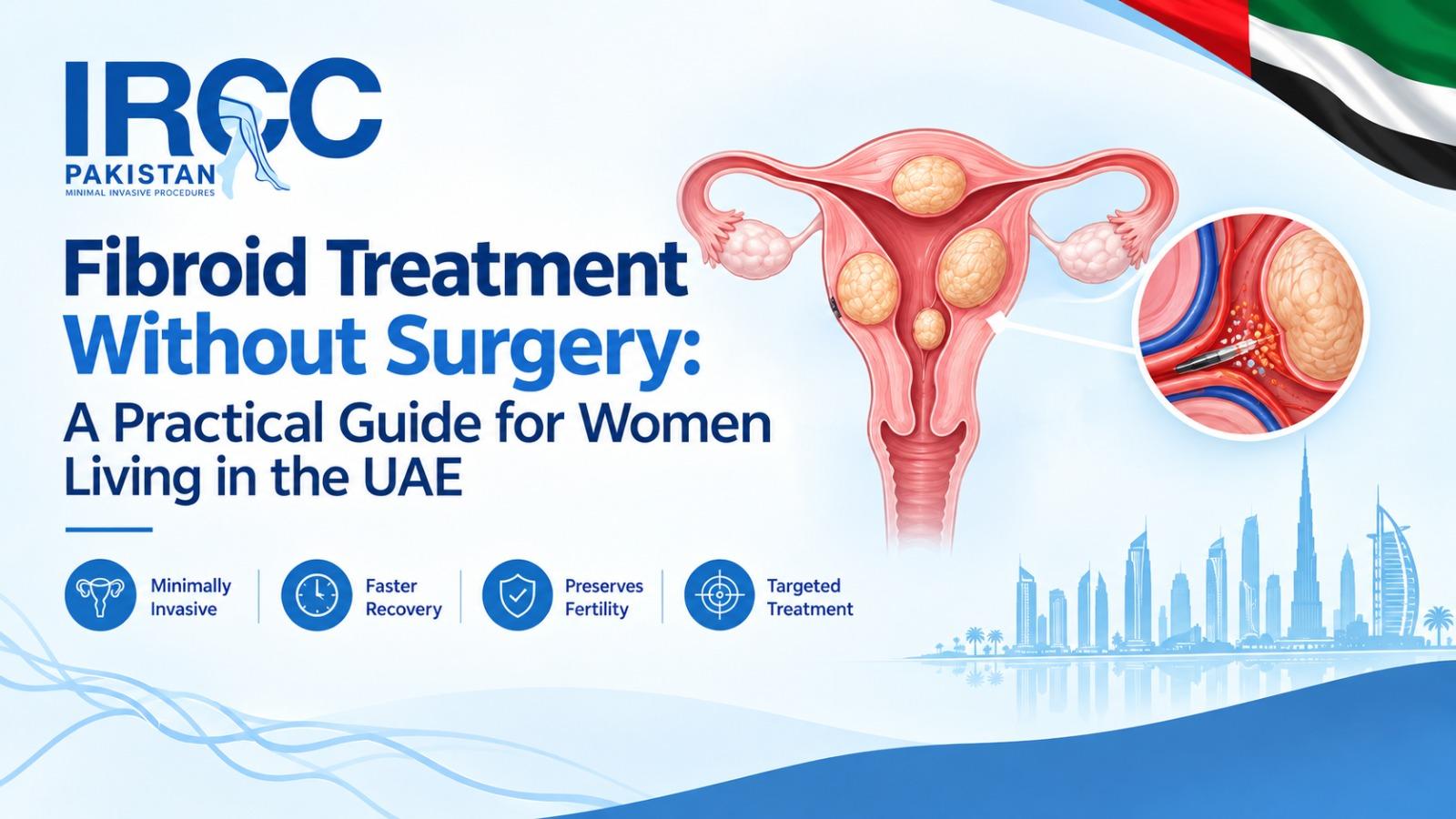
Fibroid Treatment Without Surgery: A Practical Guide for Women Living in the UAE

Fibroid Treatment Without Surgery: A Practical Guide for Women Living in the UAE

Living in Dubai, Abu Dhabi or Sharjah with fibroids? Learn how embolization works, how it compares with surgery, recovery time and what it costs in Pakistan.

Oct 16, 2026
Varicocele Treatment Without Surgery: A Clear Guide for Men in Saudi Arabia

Varicocele Treatment Without Surgery: A Clear Guide for Men in Saudi Arabia

Varicocele pain or fertility worries in Riyadh, Jeddah or Dammam? See how embolization compares with surgery, recovery time and costs in Pakistan vs Saudi Arabia.

Oct 16, 2026
Thyroid Nodule Treatment Without Surgery: A Guide to RFA for Patients in Qatar

Thyroid Nodule Treatment Without Surgery: A Guide to RFA for Patients in Qatar

Benign thyroid nodule causing a lump or pressure? Learn how radiofrequency ablation (RFA) works, who it suits, recovery and costs for patients from Qatar.

Oct 06, 2026
How Much Does Varicocele Treatment Cost in Pakistan?

How Much Does Varicocele Treatment Cost in Pakistan?

Looking for varicocele treatment cost in Pakistan? Learn what can affect your quote, what to ask the clinic and how to plan your consultation.

Oct 06, 2026
How Much Does Varicose Vein Treatment Cost in Pakistan?

How Much Does Varicose Vein Treatment Cost in Pakistan?

Learn what may affect varicose vein treatment cost in Pakistan, what to ask about laser or RFA quotes, and how to request an estimate.

Oct 06, 2026
What Affects the Cost of Uterine Fibroid Treatment in Pakistan?

What Affects the Cost of Uterine Fibroid Treatment in Pakistan?

Learn what may affect uterine fibroid treatment cost in Pakistan, what to ask about tests and follow-up, and how to request a case-specific estimate.

Sep 17, 2026
Uterine Fibroid Embolization in Pakistan: The Complete Non-Surgical Guide

Uterine Fibroid Embolization in Pakistan: The Complete Non-Surgical Guide

Thinking about fibroid surgery? Learn how Uterine Fibroid Embolization treats fibroids in Pakistan without a hysterectomy, incisions, or long recovery.

Sep 17, 2026
Varicocele Embolization in Pakistan: The Non-Surgical Treatment Guide for Men

Varicocele Embolization in Pakistan: The Non-Surgical Treatment Guide for Men

Varicocele embolization treats testicular pain and infertility without surgery, incisions, or general anesthesia. Learn how it works, recovery, and results.

Jun 02, 2026
Best Fibroid Doctors in Karachi (2026 Comparison)

Best Fibroid Doctors in Karachi (2026 Comparison)

Find the best fibroid doctors in Karachi offering UFE, minimally invasive treatment, and hysterectomy alternatives. Expert gynecologists and interventional radiologists.

Jun 01, 2026
Best Fibroid Specialists in Lahore (2026 Guide)

Best Fibroid Specialists in Lahore (2026 Guide)

Find top fibroid specialists in Lahore offering minimally invasive treatment, UFE, and surgery. Expert guide with doctor profiles, treatment options and recovery tips.

May 29, 2026
Top Uterine Fibroid Treatment Doctors in Islamabad: Your Complete Guide

Top Uterine Fibroid Treatment Doctors in Islamabad: Your Complete Guide

Find the best uterine fibroid treatment doctors in Islamabad. Expert gynecologists offering minimally invasive UFE, surgery alternatives and personalized care.

Apr 26, 2025
Pakistani Women Largely Unaware of Fibroid Embolization

Pakistani Women Largely Unaware of Fibroid Embolization

For decades, women with uterine fibroids, or benign growths inside the uterus, commonly have been offered two options to manage the symptoms-get a hysterectomy, or just deal with the pain.

Mar 15, 2025
Varicocele and Male Infertility: Is There a Link?

Varicocele and Male Infertility: Is There a Link?

Male infertility often involves low sperm count. Varicocele, swollen veins within the testicles, is a common contributor and can impact sperm health.

Feb 12, 2025
Am I in Danger if I don't Treat My Varicose Veins?

Am I in Danger if I don't Treat My Varicose Veins?

Varicose veins are bulging, twisted veins that can be seen and felt right under the skin. They commonly occur on the legs, and are present in up to 30% of people.